DATA-02Published repository
AI & Learning · Scientific-data exploration · Learning project
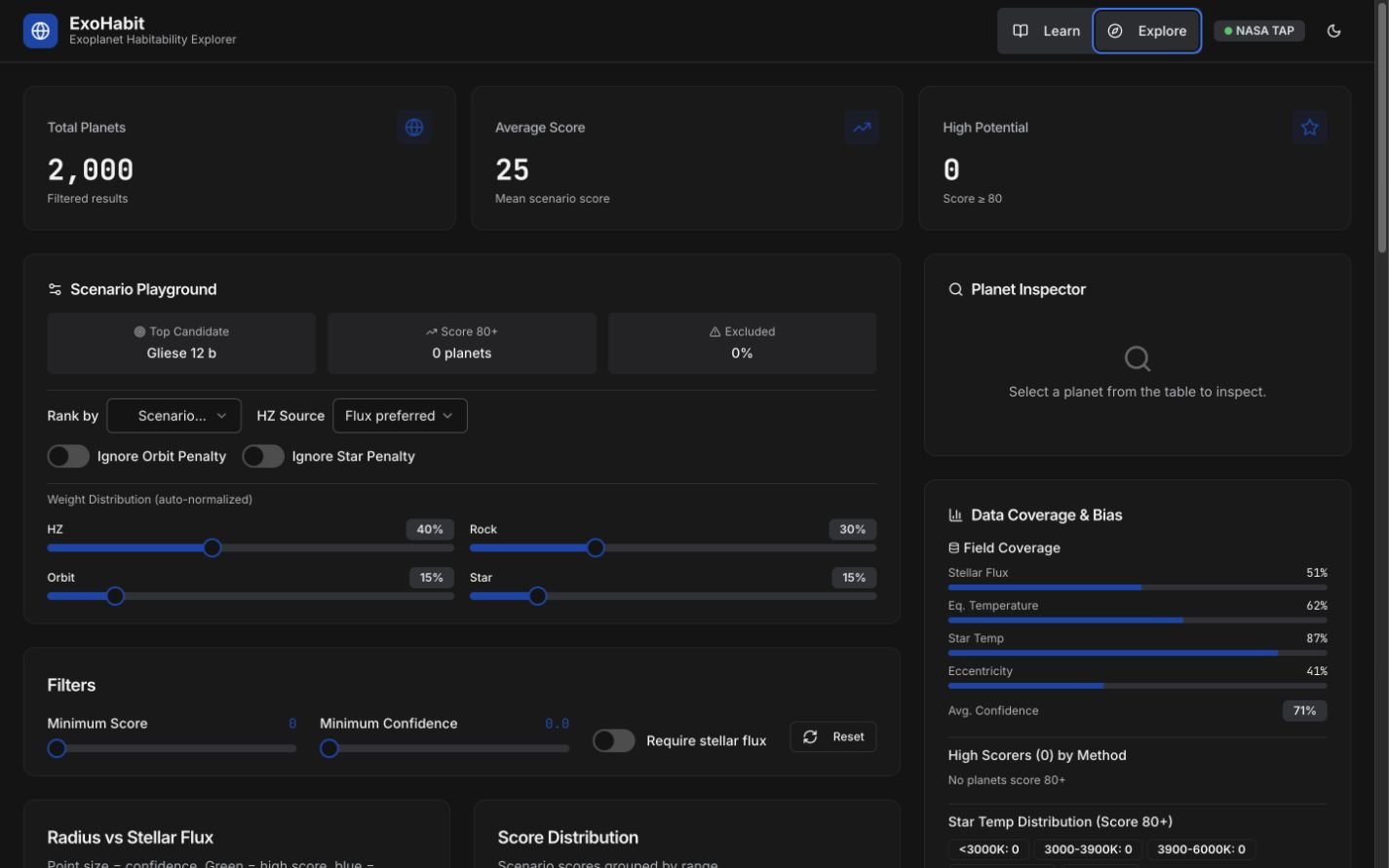
I built a TypeScript project that restructures NASA exoplanet data and uses adjustable signals to help visitors explore possible candidates.
VISUAL EVIDENCE
Live surfaces and project records.
 OPEN FULL SIZE
The problem I addressed
I wanted to make a large scientific dataset easier to explore while clearly explaining what a ranking can and cannot prove.
What I built
- Exoplanet dataset ingestion and restructuring
- Filters and ranking based on adjustable habitability-style signals
- A visual web interface for exploring candidate objects
- Clear separation between heuristic ranking and scientific confirmation
My role
I built the project while rapidly learning the scientific domain.
Why this matters to me
I use this project to demonstrate rapid domain learning, data modelling and my ability to turn a complex public dataset into an approachable exploratory product.
Decisions I made
- Used a tunable weighted score as an exploration heuristic
- Made the scientific limitation explicit instead of presenting the score as proof
- Used AI-assisted research to learn the domain while retaining a documented reasoning trail
Challenges I handled
- Cleaning unfamiliar scientific data
- Selecting interpretable proxy signals
- Communicating uncertainty honestly
System signals
- API/data integration
- Data cleaning
- Adjustable ranking
- Scientific caveat
Technologies used
TypeScriptNASA dataData cleaningWeighted heuristicsWeb UI
Current limitations
- I use the score as an exploratory heuristic, not a scientific classification
- I have not verified a public live demo